

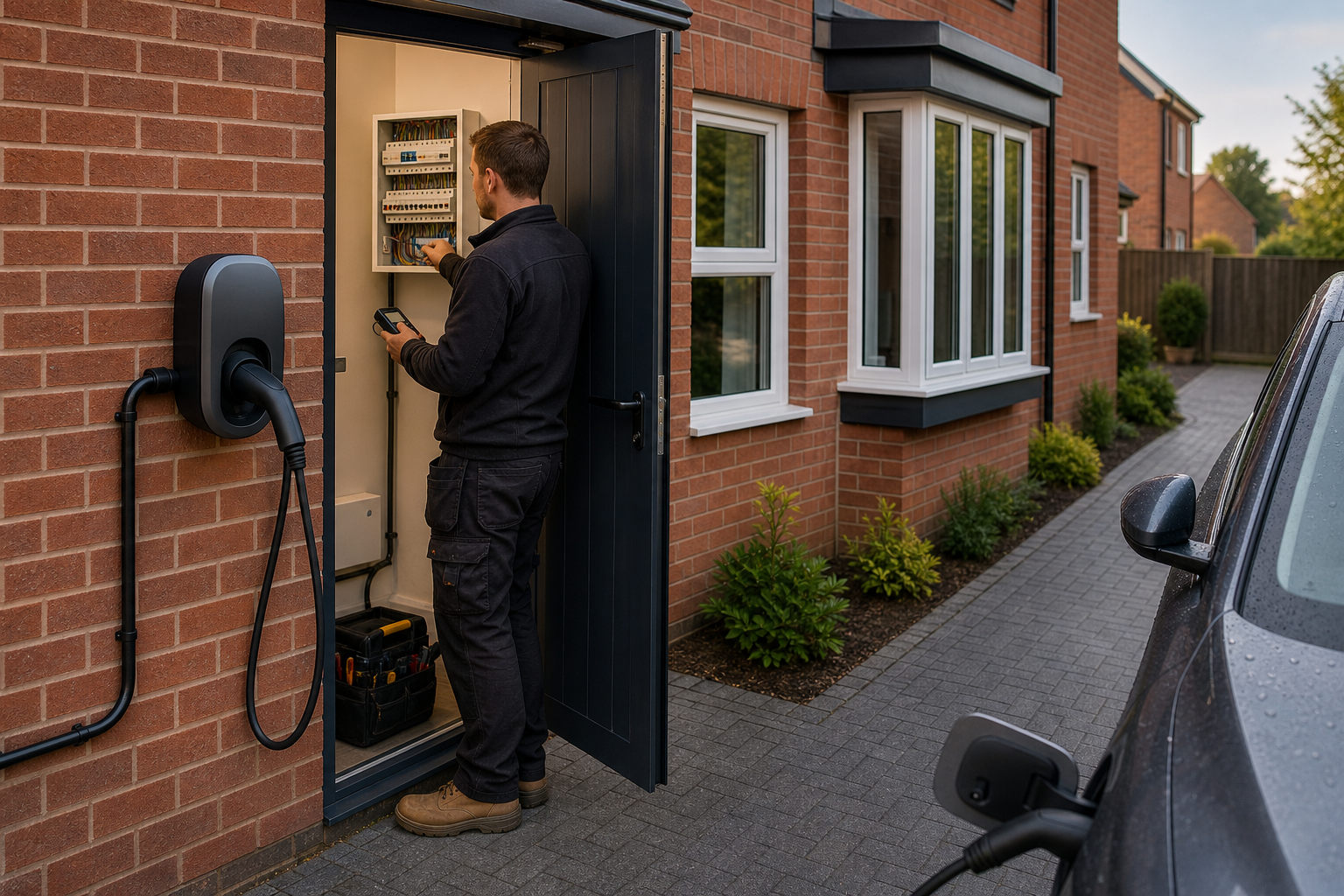
Installing an electric vehicle (EV) charger can make home charging more convenient and help reduce reliance on petrol or diesel. However, an EV chargepoint is a substantial electrical load, so the home’s existing installation must be checked before work begins. A qualified electrician can assess the supply, design a safe connection and identify any upgrades needed for reliable, energy-efficient charging.
Start with a professional electrical assessment
The first step is to arrange an inspection with an electrician who is experienced in EV charger installations. They should assess the property’s incoming electricity supply, consumer unit, earthing and bonding, existing circuits and the proposed charger location.
This assessment is important even if the home has recently been rewired. An EV charger may draw considerably more power than typical household appliances, particularly when charging alongside an electric cooker, heat pump, immersion heater or other high-demand equipment. The electrician will consider the installation as a whole rather than simply adding another circuit.
Ask the electrician to explain:
- Whether the existing electricity supply has sufficient capacity
- Which type and rating of chargepoint is suitable
- Whether a dedicated circuit is required, and how it will be routed
- Whether the consumer unit needs upgrading or replacing
- What protection and monitoring equipment will be installed
- Whether the local electricity network operator, known as the DNO, needs to be notified
Check the consumer unit and protective devices
A home EV charger should normally be supplied by a dedicated circuit from the consumer unit. The circuit must be designed with suitable cable size, protective devices, isolation and residual current protection. The correct arrangement depends on the charger, the cable route, the installation method and the characteristics of the property.
Modern EV installations require careful protection against direct and indirect electrical hazards, including residual direct current that can affect certain protective devices. The electrician may specify an EV-specific residual current device, or a chargepoint with the required built-in protection, in accordance with the manufacturer’s instructions and the relevant requirements of BS 7671.
Older consumer units may lack the space, capacity or protective features needed for a new circuit. In some cases, the best solution will be a replacement consumer unit or a separate distribution board. This should not be decided by appearance alone: the electrician should inspect the equipment, test it and explain any recommendations clearly.
Review earthing, bonding and PME considerations
The electrician will check the property’s earthing arrangement and main protective bonding. These parts of the installation help reduce the risk of electric shock and must be suitable for the proposed EV charging equipment.
Many UK properties use a protective multiple earthing (PME) supply. Where a chargepoint is installed outside, special measures may be needed to manage the risk associated with a broken neutral conductor, sometimes referred to as an open-PEN fault. Depending on the circumstances, the installation may require a suitable open-PEN protective device, an alternative earthing arrangement or another compliant design.
This is one reason an EV charger should not be connected by treating it as an ordinary outdoor socket. The electrician must assess the supply and follow the current wiring requirements, the chargepoint manufacturer’s instructions and any applicable DNO guidance.
Plan the cable route and charger position
The shortest route is not always the best route. The electrician should consider how the cable will travel from the consumer unit to the chargepoint, whether it will pass through walls or external areas, and how it will be protected from impact, moisture, heat and future building work.
Before the appointment, decide where the car is usually parked and whether the charging cable can reach the vehicle without crossing a public footway or creating a trip hazard. A chargepoint mounted close to the parking position may reduce cable length and installation materials. It should still be positioned where it is accessible, protected from likely damage and convenient to use.
Discuss the appearance of external cable runs, too. Cables may be concealed within suitable building fabric, routed neatly on an exterior wall or protected in an appropriate containment system. Any holes through walls should be sealed properly against water ingress, and the installation should respect fire safety and the construction of the building.
Consider the home’s future energy needs
Preparing for an EV charger is also an opportunity to think about the home’s wider energy system. If you are considering solar panels, a battery, a heat pump or electric heating, tell the electrician before the design is finalised. A coordinated approach can avoid unsuitable equipment or duplicated work later.
Smart charging can help shift vehicle charging to times that suit your tariff, vehicle use and available renewable generation. In the UK, domestic smart chargepoints are subject to legal requirements covering matters such as smart functionality, security and default charging behaviour. Your electrician should confirm that the selected unit is suitable for the intended use and installed according to current requirements.
Load management may also be appropriate. This allows the charger to adjust its demand when other high-powered appliances are operating, helping to make better use of the available supply. It is not a substitute for a proper assessment, but it may help avoid unnecessary capacity upgrades where the equipment and installation design support it.
Check permissions, notifications and documentation
Some installations require notification to the local DNO, and the process can vary according to the charger rating and the property’s supply. An electrician should confirm whether notification is required and deal with the relevant technical information.
Planning permission is not normally needed for a standard domestic chargepoint, but restrictions can apply to listed buildings, conservation areas, flats, leasehold properties or homes with communal parking. Check with the local planning authority, landlord, freeholder or managing agent where relevant.
After the work, you should receive appropriate certification and information about the installation. Keep the electrical installation paperwork, operating instructions, warranty details and any DNO correspondence. Ask the electrician to explain how to isolate the charger, what the indicator lights mean and how to report a fault.
Prepare the property before the electrician arrives
- Clear access to the consumer unit and proposed chargepoint location
- Confirm where the car will normally be parked
- Identify any loft, cupboard or wall areas where cables may need to pass
- Tell the electrician about solar panels, batteries, heat pumps or other large electrical loads
- Gather information about the vehicle and preferred charger
- Check whether landlord, freeholder or planning approval is needed
- Ask for a written quotation that separates equipment, installation, testing and any remedial work
Do not rely on a low headline price if it excludes essential upgrades or testing. A clear quotation should explain the proposed design, the charger model, cable route, protective equipment, certification and any assumptions about the existing installation.
Book a qualified electrician for safe EV charging
A properly prepared electrical installation can make home charging safer, more dependable and easier to integrate with renewable energy. For an assessment, upgrade or complete EV charger installation, book an electrician through Task Pigeon and find a professional to help prepare your home with confidence.